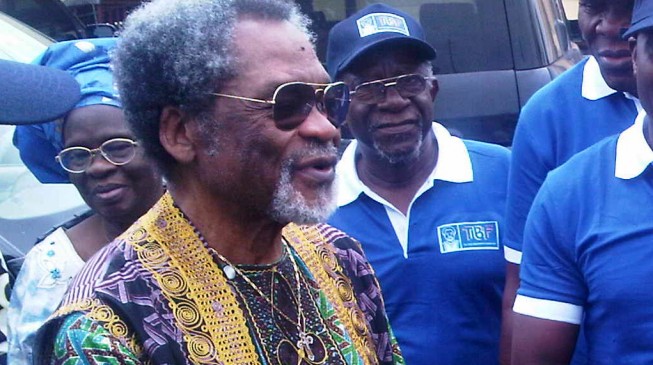
If
you only knew Tunji Braithwaite the lawyer and activist, you never
really knew him in his true colours. The latter-day Braithwaite, who
died at St Nicolas Hospital, Lagos, on Monday, was less of a charming
politician but more of a pro-democracy advocate.
TheCable
understands that although the 82-year-old grandfather had been battling
prostate cancer for a while, he was energetic until one early morning
last week he went for his daily exercise routine.
A family source
told TheCable: “He woke up and was by his outward appearance healthy.
But he decided to use the treadmill, which was part of his daily
routine. The wife later went to check on him and found him unconscious.
It appeared he fell down and it was suspected that he hit his head and
had a concussion. But when he was taken to the hospital, all scans
showed that he did not hit his head.”
He never came back to
consciousness, TheCable was informed, and he finally died on Monday
afternoon “despite the best efforts of the doctors”.
Many older
Nigerians will remember Braithwaite the politician of the 1983
elections, whose party, Nigeria Advance Party (NAP), was the only one
registered by the electoral commission to join the five existing ones
earlier approved by the military government in 1979.
Braithwaite
was not alone in NAP, though. He had intellectuals with him, with Wole
Soyinka, the professor and future Nobel Laureate, being the most
prominent. Soyinka, ahead of the elections, recorded a song which almost
replaced the national anthem: “I love Nigeria I no go lie/Na inside am I
go live and die…” Those lines made a monster hit.
Mushin and Victoria Island
But
Braithwaite left Nigerians with more memorable lines in his
presidential campaign – he was the flag bearer of NAP in the ill-fated
election – and his TV commercial was an instant hit.
“I will kill
all the rats, cockroaches and mosquitoes,” he would say to the camera,
in marketing his anti-corruption ideas to the electorate. It was a
message that was too coded for the ordinary voter to understand.
But
much more difficult to understand, even hilarious, was his promise to
move residents of Mushin to Victoria Island, and residents of Victoria
Island to Mushin.
Unknown to the street people, he was only
propagating his socialist ideals of addressing the inequalities in the
Nigerian society, with Victoria Island representing the bourgeois class
and Mushin the proletarian, the commoner. He would redistribute the
wealth and make everybody equal in the society, he said in poetic
language.
Needless to say his campaign did not resonate with the
people he wanted to help: he came last in the presidential election with
271,000 votes. Shehu Shagari, the sitting president, had 12 million.
Violence ensured thereafter and the military overthrew Shagari a few
months later.
Braithwaite returned to politics with NAP but with
less colour in 2003 and his party was removed from the register by the
electoral commission in 2012 for not winning an election at any level.
A family of firsts
In
1933, the celebrated lawyer was born into record-setting family
Braithwaite family in Lagos. In 1880, I. Braithwaite, a reverend, led
the first Anglican missionary expedition which introduced the
gospel to the Ijebu province in today’s Ogun state.
In 1894, the
reverend built St. Michael’s, the first church in Epe in today’s Lagos
state, after his efforts led to the growth of church attenders. There is
now a second Anglican church – the Reverend Braithwaite Memorial
Anglican Church – in Papa Epe.
Talabi, Tunji’s elder brother, is
one of the pioneers of the insurance industry in Africa. In fact, he
emerged the first chartered insurer from Africa when he became an
associate of the Chartered Insurance Institute of London in 1951.
He
set up T.A. Braithwaite (Insurance Brokers) & Co. Ltd. in April
1958, the first indigenous insurance broking company in Nigeria.
Tunji,
the last of eight children, was schooled at C.M.S Grammar School from
1946 to 1953. He did his A Levels at the London University at
Kennington College in 1955. In 1957, he enrolled at the Council of Legal
Education, London. He was admitted into Lincoln’s Inn that same year
and graduated as a barrister in 1960.
His married his childhood love, Grace, in 1956 and they had five children.